
Should academic conferences, events in general, or even public canteens adopt meat-free options to reduce their carbon footprint? Going further, should they go further to make it the official menu?
Throughout this post, I will provide some arguments on this debate, especially in the context of a scientific conference about sustainability.
A particular case
The idea did not come out of thin air. In fact, I recently participated in a scientific conference dedicated to the bioeconomy, i.e. using biomass as a more sustainable resource for society (at best ideally). Notwithstanding the interest, I am not going to expand on what was presented there. Instead, I will focus on one particular aspect of the event itself: the meat-free catering and its surprising low acceptance among participants of the conference, at least from what I could hear.
The onset of debate was even before attending the conference itself, when the organizer announced the entirely vegetarian catering during the event (including four lunches and two dinners in total). They advertised this as a way to reduce the event’s environmental footprint on their website. Already, one colleague was sceptical about this choice, seeing it as hypocritical, assuming an insignificant contribution of food to the overall conference footprint. This colleague even denounced an attempt of greenwashing. The consequences of this marketing would just be distracting us off from truly impactful measures, such as cutting air-travel-related emissions of the attendees.
Overall conference footprint
In fact, my colleague has a point regarding the tiny contribution of such catering-related action compared to tackling travel emissions. I already mentioned the issue of air travel when going to scientific conferences in a previous post. In retrospect, the argumentation remained shallow about the substantial fraction of the related emissions to scientific conferences’ footprint. Henceforth, the post was updated to bring an additional section with references discussing this point specifically. Check it out here.
Undoubtedly, refusing the plane for a low-carbon mode of transportation has a strong chance to be the most potent way to reduce greenhouse gas (GHG) emissions in this context. Does that still make the vegetarian food announcement an unfortunate case of greenwashing? I am not giving up.
The organizer does not have complete control over reducing emissions from air travel, and some academics may be too far away to take any action beyond simply not going. So what other mitigation levers do conferences really have? They primarily include materials (goodies, badges, books), conference venue and catering. Goodies are a waste of resources and money and should be avoided as a symbolic measure, the venue is outside the scope of this article. In contrast to gadgets, food-related impacts can only be addressed via substitution, let me develop.
Meat-free, a solution?
According to published studies on the topic, food represent less than 5% of international conferences’ carbon footprint1,2. Despite meals contributing to a tiny fraction of the event’s footprint, they should not be overlooked. If we take the parallel of aviation compared to global annual anthropogenic GHG emissions, it is just as low as about 3% of the billion tons (Gt) of CO2 equivalent (Gt CO2-eq)3. This still represents around 1.7 Gt CO2-eq, which is more than five times the yearly direct GHG emissions of France (0.3 Gt CO2-eq in 2024)4. Put this way, it sounds much less negligible. I presume we should refrain from judging sectors to mitigate from a relative share perspective because it can inadvertently divert us from measures with enormous potential with low efforts. Here, the case of food is particularly within easy reach, it does not require participants more time or money, they solely get served a different meal.
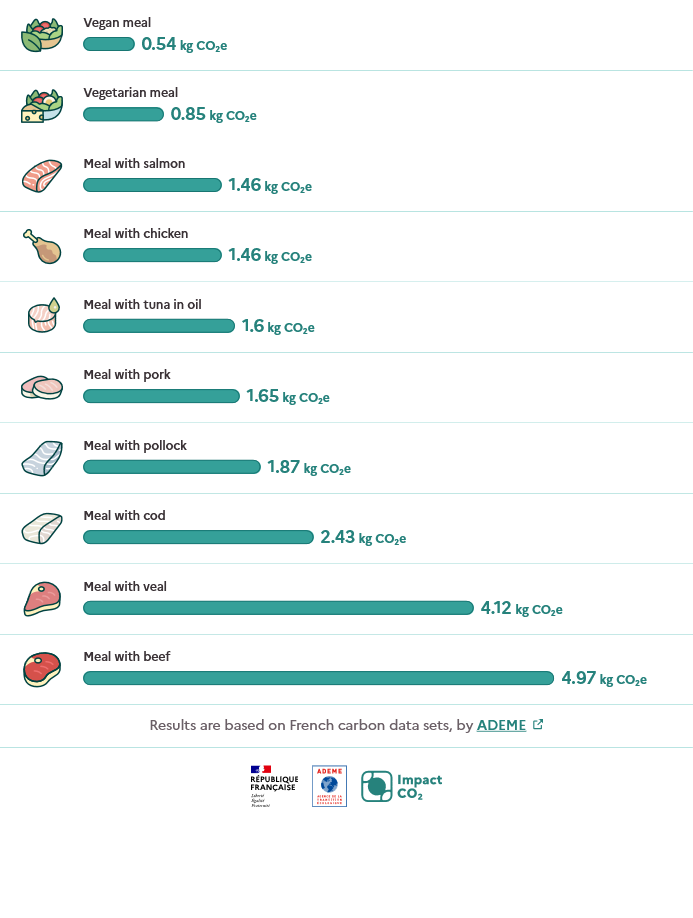
Considering the individual footprint of a meal and the difference between meat-containing versus meat-free alternatives, there is some potential for conferences to reduce this entry in their overall carbon footprint. Indeed, compared to meat-based or even omnivorous diets, GHG emissions can decrease considerably, i.e. up to ten-fold, when switching to a vegetarian or even non-animal-based (vegan) meal, depending on the reference point5,6,7,8. Researchers even showed that the lowest animal-based protein footprint still has a higher carbon footprint than the average GHG footprint of plant-based protein8.
Figure: ADEME comparator of average meal carbon footprints, based on French life cycle assessment data10 (unit: kg CO2-eq per meal).
The ultimate positive post-conference aftermath would be reached if the experience triggers changes in habits. Benefiting from not having to prepare the food, participants who are not used to this diet have the opportunity to try it and possibly realize that it can be fun, tasty, and healthy. We humans often depend on first experience, I believe. Put into perspective, the food system represents one quarter of global anthropogenic GHG emissions8, far from a few percentages.
Besides, extra care should be taken on the nutritional aspects, aiming at full coverage of the essential nutrients. Although neither plant-based nor omnivorous diets imply healthy consumption, dietary efforts could improve the acceptance among participants. The organizer can easily select a recognized catering service with such experience. Maybe some participants would even end up with a healthier diet while at the conference than usual.
Freedom and leadership
Now, I also heard participants complaining about being forced into a diet. One went on to claim that it was “not inclusive towards meat-eaters (sic)”. Some defended that offering the choice would be sufficient.
While I fundamentally hope we had the choice, I don’t think we always do if we are to meet the climate pledges. Can society wait before everyone freely adopt new sustainable habits without intervention? There are many things that are not possible and that we don’t put into questions. Part of the reason is that we live in a world constrained by matter (e.g., resources, climate change) and social norms. More generally, it is difficult for me to tell what is good or bad, acceptable and not. But at some point it all comes down to making choices and this can hardly be disconnected from ethics and value choices, not being entirely accessible through facts and figures6,13. This is a political discussion that we need to have to advance towards more sustainable scientific practices.
Additionally, leading by example is key for us, scientists working on the topic if we want to be trusted and to see the changes we expect in our models1,15,16. We are supposedly more aware of the situation than the general population, we know of the solutions and how they compare to each other in terms of potential. Moreover, we have room for action, working with relatively large autonomy, especially regarding how we conduct our research. Therefore, we should be among the first to make the initial step towards more sustainable practices and lifestyles. That is why I welcome such decisions as a conference going meat-free, not seeing any tangible harm toward people’s health and freedom.
Discussion about the carbon perspective
Throughout this article, I have focused on the carbon footprint. Climate change is a major issue for our society, with rapid and global consequences to come if our actions to mitigate and adapt are not met with solutions of sufficient scale and speed. In addition, this is a topic I still know better than other important societal concerns, ranging from pollution, animal welfare, equity… Yet, the GHG emissions related to meat-based diets are not their only negative impact. Despite trying to inform myself and acting about it as much as I can, writing about them here remains challenging for me. My feeling is that these other issues do not even need to be called upon through this post. Indeed, sustainability conferences promote climate change mitigation solutions, while at the same time acting against it. This incoherence can easily be underscored and discussing with this carbon-focused scope. Nevertheless, it is encouraged to do our best to free ourselves from siloed standpoints and embrace the more complex system with live in.
Conclusion
Is alternative catering during events even unusual? Not from my experience. I did my PhD research stay at Utrecht University in The Netherlands for a few months in 2025. It was ordinary practice for the sustainable development department to organise vegetarian events. This is not the first time I observe this for large public events, including in the non-work-related context.
In conclusion, it can make a lot of sense for the organizer to implement and promote meat-free catering. Not only it is an easy way to reduce some of the event’s environmental footprint, but also it can potentially trigger lasting habits changes among participants holding much bigger potential. Conferences and events could go even further by opting for vegan service with even more benefits.
Although these catering choices are welcome, conferences cannot in turn advertise themselves as “sustainable” when most greenhouse gas emissions stem from participants air travel. This is a modest but still meaningful contribution to the global effort.
Acknowledgments
I want to thank my colleagues Kevin Bertin and Tanguy Fardet for their thoughtful and challenging comments on the article draft.
References
- Astudillo, M. F., & AzariJafari, H. (2018). Estimating the global warming emissions of the LCAXVII conference: Connecting flights matter. The International Journal of Life Cycle Assessment, 23(7), 1512–1516. https://doi.org/10.1007/s11367-018-1479-z ↩︎
- Neugebauer, S., Bolz, M., Mankaa, R., & Traverso, M. (2020). How sustainable are sustainability conferences? – Comprehensive Life Cycle Assessment of an international conference series in Europe. Journal of Cleaner Production, 242, 118516. https://doi.org/10.1016/j.jclepro.2019.118516 ↩︎
- Bergero, C., Gosnell, G., Gielen, D., Kang, S., Bazilian, M., & Davis, S. J. (2023). Pathways to net-zero emissions from aviation. Nature Sustainability, 6(4), 404–414. https://doi.org/10.1038/s41893-022-01046-9 ↩︎
- Bergero, C., Gosnell, G., Gielen, D., Kang, S., Bazilian, M., & Davis, S. J. (2023). Pathways to net-zero emissions from aviation. Nature Sustainability, 6(4), 404–414. https://doi.org/10.1038/s41893-022-01046-9 ↩︎
- Official ADEME simulator. Beware that most of the data apply to French context. Available in English: https://impactco2.fr/outils/transport ↩︎
- Goldstein, B., Hansen, S. F., Gjerris, M., Laurent, A., & Birkved, M. (2016). Ethical aspects of life cycle assessments of diets. Food Policy, 59, 139–151. https://doi.org/10.1016/j.foodpol.2016.01.006 ↩︎
- Scarborough, P., Clark, M., Cobiac, L., Papier, K., Knuppel, A., Lynch, J., Harrington, R., Key, T., & Springmann, M. (2023). Vegans, vegetarians, fish-eaters and meat-eaters in the UK show discrepant environmental impacts. Nature Food, 4(7), 565–574. https://doi.org/10.1038/s43016-023-00795-w ↩︎
- Poore, J., & Nemecek, T. (2018). Reducing food’s environmental impacts through producers and consumers. Science, 360(6392), 987–992. https://doi.org/10.1126/science.aaq0216 ↩︎
- Poore, J., & Nemecek, T. (2018). Reducing food’s environmental impacts through producers and consumers. Science, 360(6392), 987–992. https://doi.org/10.1126/science.aaq0216 ↩︎
- ADEME ImpactCO2, https://impactco2.fr/outils/alimentation?&language=en#repas ↩︎
- Poore, J., & Nemecek, T. (2018). Reducing food’s environmental impacts through producers and consumers. Science, 360(6392), 987–992. https://doi.org/10.1126/science.aaq0216 ↩︎
- Goldstein, B., Hansen, S. F., Gjerris, M., Laurent, A., & Birkved, M. (2016). Ethical aspects of life cycle assessments of diets. Food Policy, 59, 139–151. https://doi.org/10.1016/j.foodpol.2016.01.006 ↩︎
- Sandel, M. J. (2009). Justice: What’s the right thing to do? (1st ed). Farrar, Straus and Giroux. ↩︎
- Astudillo, M. F., & AzariJafari, H. (2018). Estimating the global warming emissions of the LCAXVII conference: Connecting flights matter. The International Journal of Life Cycle Assessment, 23(7), 1512–1516. https://doi.org/10.1007/s11367-018-1479-z ↩︎
- Attari, S. Z., Krantz, D. H., & Weber, E. U. (2016). Statements about climate researchers’ carbon footprints affect their credibility and the impact of their advice. Climatic Change, 138(1), 325–338. https://doi.org/10.1007/s10584-016-1713-2 ↩︎
- Steve Westlake’s research about sustainability leadership (not read): https://scholar-google-com.gorgone.univ-toulouse.fr/citations?user=EM_MuTgAAAAJ&hl=en ↩︎
Leave a Reply