
I just came back from a conference in Palermo, a city located on the Sicilian island in Italy. I travelled more than 4 500 km in total by taking low-carbon transport only. Through this article, I wanted to share this wonderful experience. I hope that it will inspire you as well, so we can together make academic/business trips more sustainable!
Why not going by plane
I have been flying since I was born in New Caledonia which, being a relatively small island and with relatives spread across France and the USA, did not leave many options but to take the plane often. Since 2020, while I was still pursuing my master in France, I took the decision to stop taking the plane. Although unsure of the feasibility of holding such a challenge in the future, I have successfully managed until then and will keep pushing for it. Why does this matter at all?
Aeroplanes have one of the highest carbon footprints among public transports in terms of passenger-kilometre (i.e. equivalent to moving one person over one km). While the footprint is relatively close to driving a thermal engine car (i.e. 218 g CO₂-eq1 for car and 188 g CO₂-eq for plane on average), the impact of flying lies in the increased distance that it permits. Going thousands of kilometres away is made simple, especially considering it is often difficult to compete to its price tag and speed. Hence, it is easy to accumulate plenty of kilometres, along with the greenhouse gas emissions (GHG) that come with it.
From my experience, I realized the issue when I read the CO2 emissions reported on the boarding pass of my latest trip from France to New Caledonia (2019), disclosing 1 100 kg CO2/person estimation (one way, economy). How could I be responsible for producing such a considerable amount of gas by myself? Even more striking was when I came across the now famous BonPote blog, stating that a round trip from France to Australia would emit approximately 6 tons of CO2-eq2. Sydney was just a connection for my trip back to home, how come? Considering this, it became no longer possible for me to keep taking the plane unconsciously, like if it was typical public transport. Over the past few years, it has been more or less easy for me to avoid it. Those occasions were only related to private life and solved by pushing for local or trips in Europe with friends, where the train was a conceivable option (I also took the ferry to Corsica twice). As time went by, people around me became aware of my self-imposed constraint, accepted it and adapted. Like switching to a vegetarian diet, it just takes a bit of time for people to get used to your new habits. The situation work-wise was also well suited, my previous positions did not require international travel. However, now that I am conducting a PhD, things have become challenging in respect to the international setting of academic work.
What are academic conferences
For the reader who is not familiar with academia and research, fellow researchers and PhD candidates alike are expected to share their findings among the community. They are employed by public institutions (in the majority of the case) and they are expected to make their discoveries publicly accessible as part of their contract. There are two complementary ways to achieve this. One is the publication into peer-reviewed scientific journals. The other way is to go to (inter)national conferences to present in person. Besides staying updated to recent discoveries, these are the occasion to meet with the top recognized experts of the field. Researchers submit their proposal for presentation or poster based on a short summary with some key findings called an abstract, then a selection committee reviews all applications and picks abstracts justifying original research work that is relevant for the conference. If your abstract submission is accepted, you are expected to present at the conference. Conferences generally imply international trips considering the often global scale of research fields.
Air travels can play a significant role in the climate footprint of scientific conferences. Indeed, going by plane is a usual mode of transportation, with conferences largely being led in places not close to every participant’s home laboratory3. Researchers would mostly attribute the choice of air travel to a lack of alternative options and time constraints4. However, this has a huge carbon footprint, in many cases it is even responsible for most of the event’s GHG emissions3,6. The same may apply to a researcher’s overall footprint7. Avoiding conference-related travel emissions either means that attendees choose not to come or take a different mean of transportation. While the first is not ideal (even though it should also be considered), the second is a shared responsibility between the organizers and its attendees. The conference can (and should) adjust the location and incite participants to opt for a low-carbon trips (financial support, planning)6.
Planning
I identified two relevant conferences and got accepted to both. However, one was in Singapore, which did not let the room for a possible alternative to the plane. Luckily, the other one was in Palermo (Italy, on Sicilian island). The preparation started with a Google Maps, making me realize the 2300 km separating Toulouse and Palermo on land, and that there is no bridge connecting continental Italy and Sicily. Options seemed difficult to find but I was gradually getting a sense of the mains cities from which connections were possible, by leveraging websites like Trainline and Railee. The turning point was when my colleague Damien, who was also planning to attend the same conference, told me that he would also go for low carbon transport. Kudos to him as he recently went to another conference in Goteborg by train from Toulouse. Knowing we were now forming a team with the same objective raised motivation. On top of that, I was recommended to talk to a researcher from Rennes who had recently gone to Palermo by train to attend another conference there. Inspiration from others’ experiences was really a powerful source of motivation, hence this blog post!
We discovered that there is a daily night train going from Rome to Palermo. We initially thought this was a bug on the Trenitalia website before knowing that this InterCity Notte train actually takes the ferry: It is boarded on an on-purpose ship equipped with rails, allowing to cross the handful kilometres separating continental Italy with the Sicilian island, avoiding an additional train and a dedicated ferry connection. This train alone represents a big 900 km direct trip, and it is equipped with comfortable coaches, optimally travelling by night and arriving on time for the beginning of the conference, what a dream! From Toulouse, it was only possible to reach Italy by train via Ventimiglia, implying 3 different trains, which had to be followed by one train to Genoa, then another to Rome to catch the night train. This was going to be a 6 trains trip in total, which was a bit too long and costly. Then we considered taking one direct night bus connecting Toulouse and Genoa (750 km, 45 €, 11h). This final plan was making the trip particularly efficient with one bus and two trains to travel over 2 300 km, especially to an island! We ended up booking our trip, departing Sunday at 11:55 pm and arriving on Tuesday at 12:30 pm in Palermo, which was right on time to have a good Italian lunch in Palermo and start the conference in the afternoon.
The trip
Travel had unexpectedly beautiful views over the Mediterranean all along the way, some were definitely postcard sceneries. Below are some pictures I took from the window. Note that the speed made it difficult to capture the best angles and I certainly missed the best views.
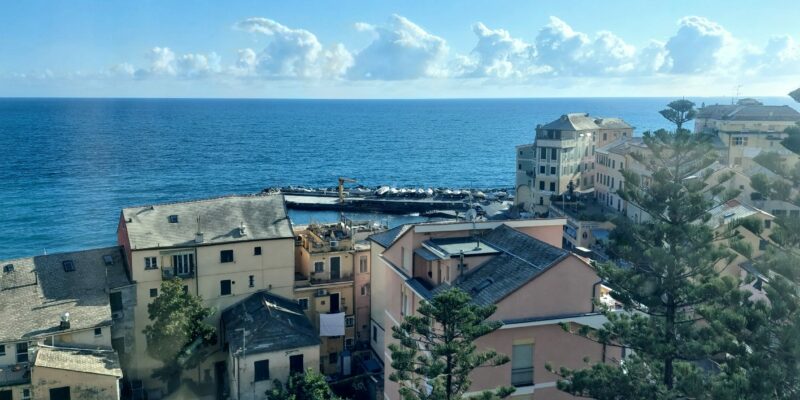

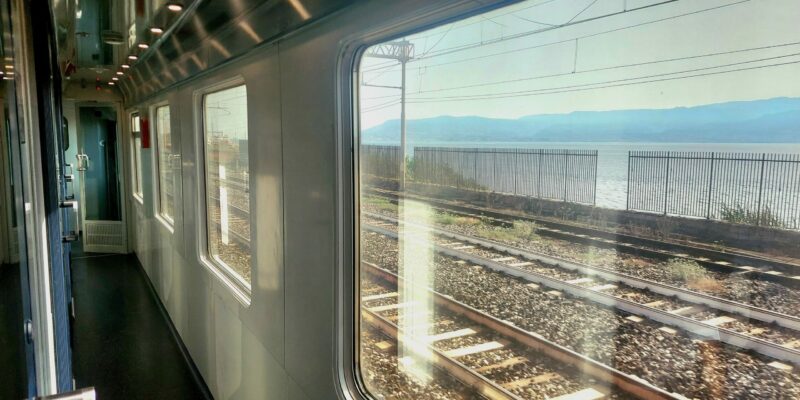

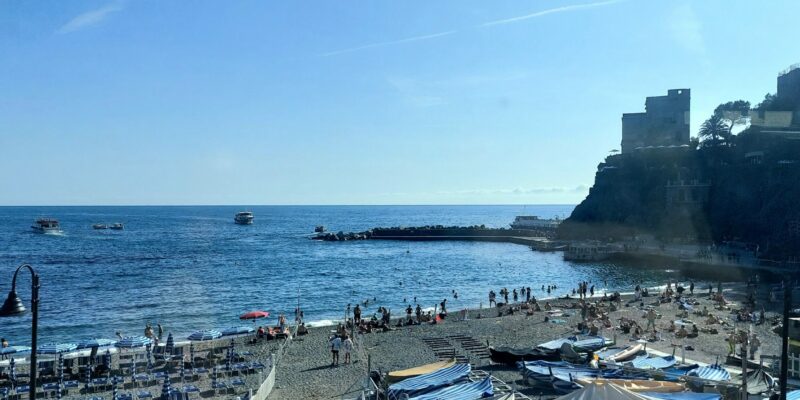



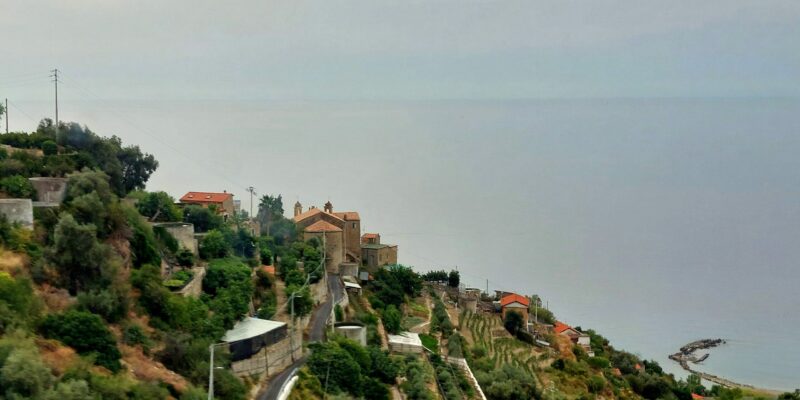


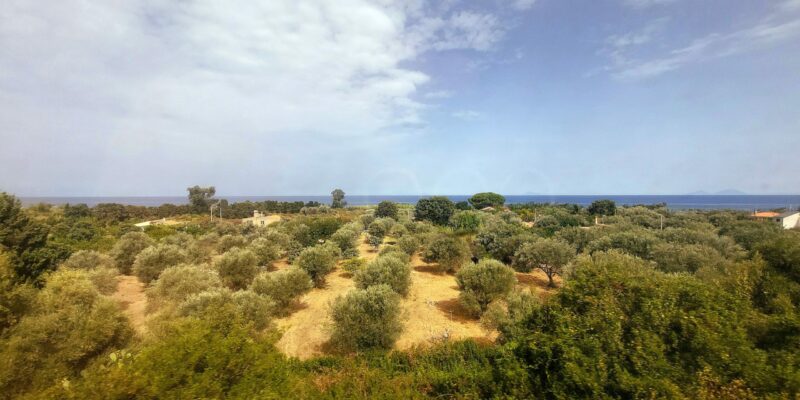


This travel took some time, undoubtedly more than by flying there — let’s not forget about the time it takes reaching the airport and completing the different formalities. Despite this, the train has its advantages, like offering a decent work environment so you can keep track of your project. For example, I have been able to do some interesting bibliography, improving some Python code together with my colleague Damien, but also performing a recap of the very intense conference, based on my pages of notes and dozens of pictures. Ordinarily you will find more space, current to charge your electric equipment, Wi-Fi connection or mobile network access. However, I still advise planning as if it were not the case, therefore downloading and printing resources in advance, properly charge your devices, bring a powerbank. Do not hesitate also carry a pair of earplugs or noise-cancelling headphones which they can prove ideal to isolate yourself from uncontrollable sources of noise. By the way, relax rules regarding the luggage is another underestimated advantage of this kind of transport, as you can often carry more belongings than with the plane.
Talking about price
Speaking of price, to our greatest surprise, our journey costed about €260 for the round-trip, including the sleeping bed in the InterCity (saved hotel cost). Who could have imagined that I would beat the price of the flight? Yes, we are cheaper (over €500 for plane alternative)!
Carbon footprint
Now you may be wondering what is the actual gain in terms of avoided GHG emissions of this trip, as this was the goal anyway. It is estimated to 110 kg of CO₂-eq for the roundtrip (44 kg for bus, 12 kg high-speed train, 57 kg of intercity). In comparison, using a direct flight is estimated at approximately 430 kg CO₂-eq accounting for non CO₂ emissions. In an alternative scenario including a connection in Munich (Germany), which is in reference to colleagues, it rises to about 900 kg CO₂-eq. Our alternative leads to almost four times fewer emissions than the direct plane, and almost height times less than the realistic option including the connection.
Absolute value is also important to consider here, when by 2050 a maximum average of less than 2 tons will be possible by capita to maintain climate change temperature increase below 1.5 °C. Emitting nearly one ton of CO₂-eq for a one-week conference travel, not even accounting for other emissions related to the event itself, makes it hard or to next impossible to comply with an egalitarian share of emissions. Some may argue that their reason for travelling are more valuable, thus having a higher priority than other people needs, which is something I find ethically hard to justify or even to demonstrate.
More on GHG calculations
- Emissions are reported for round-trip, from Toulouse to Palermo
- Train and bus distance was calculated using Google Maps estimated distance by car, which appeared to be following approximately the same path as the rails.
- Plane’s emissions were calculated as going straight line (quite optimistic assumption)
- Plane’s condensation trails (non CO₂ emissions) are accounted for as they contribute to additional greenhouse effect.
- Connection in Germany is considered as separating two different trips. The sum of distance would make it a long-haul flight which shows lower CO₂-eq emissions per km•passenger. This maybe considers the two take-offs involved and the flying altitude (not sure about that).
- ADEME ImpactCO2 online tool was used to make the estimation9.
- Impact of train was adjusted to consider the different electricity mix in Italy, which is about 5x more impactful as compared to France according to Ecoinvent 3.11 cutoff10.
We need you as well
I do not intend to blame anyone taking the plane with this post, it is just a contribution to raising awareness among the academic community about the climate cost of air-travel. More generally, professional and personal travels should reconsider the choice of transport and the location, whenever possible. Doing this kind of “personal” action with a couple of colleagues is a good step forward, but it will remain a symbolic choice, clearly insufficient to face the global issue. The changes expected from our society to reach climate goals are huge, thus every citizen and organization have to be involved. Conference organizers and academic institutions should grasp the concern and take bold and determined action to reduce air-travelling, taking the burden off the shoulders of a few individual researchers.
Chances are that attending conferences or travelling in general may not be as budget- and time-efficient as when flying was still an option. While on this particular occasion we managed to beat the cost of a plane ticket, there will be instances when it will be difficult to travel in a reasonable amount of time and money. We will need to weigh up whether it is worthwhile to attend a particular conference at all, and we may have to refuse some “opportunities”11 (including some in-person project meetings or jury participation, present).
One very positive personal outcome that may be underestimated with this kind of action is the happiness of achieving a meaningful challenge that can make oneself proud.
This was my first experience of low carbon international travel for work. Feel free to offer any suggestions. I would be happy to read your personal experience as well, even the less enjoyable ones.
Acknowledgments
I am grateful to Lorie Hamelin, my PhD supervisor, who made all of this possible!
References
- g CO2-eq unit is used when several greenhouse gases are emitted which have different impacts on the climate system than carbon dioxide (CO2). All emissions are scaled to an equivalent a mass of CO2 to allow comparison of different products or services. Conventionally, the conversion relies on the Global Warming Potential over 100 years timeframe (GWP100) of the different gases. ↩︎
- https://bonpote.com/en/train-vs-plane-second-round/ ↩︎
- Neugebauer, S., Bolz, M., Mankaa, R., & Traverso, M. (2020). How sustainable are sustainability conferences? – Comprehensive Life Cycle Assessment of an international conference series in Europe. Journal of Cleaner Production, 242, 118516. https://doi.org/10.1016/j.jclepro.2019.118516 ↩︎
- Burian, I. (2018). It is up in the air: Academic flying of Swedish sustainability academics and a pathway to organisational change. Master Thesis Series in Environmental Studies and Sustainability Science. http://lup.lub.lu.se/student-papers/record/8947780 ↩︎
- Neugebauer, S., Bolz, M., Mankaa, R., & Traverso, M. (2020). How sustainable are sustainability conferences? – Comprehensive Life Cycle Assessment of an international conference series in Europe. Journal of Cleaner Production, 242, 118516. https://doi.org/10.1016/j.jclepro.2019.118516 ↩︎
- Astudillo, M. F., & AzariJafari, H. (2018). Estimating the global warming emissions of the LCAXVII conference: Connecting flights matter. The International Journal of Life Cycle Assessment, 23(7), 1512–1516. https://doi.org/10.1007/s11367-018-1479-z ↩︎
- Kalmus, P. (2016, February 11). How Far Can We Get Without Flying? – YES! Magazine Solutions Journalism. YES! Magazine. https://www.yesmagazine.org/issue/life-after-oil/2016/02/11/how-far-can-we-get-without-flying ↩︎
- Astudillo, M. F., & AzariJafari, H. (2018). Estimating the global warming emissions of the LCAXVII conference: Connecting flights matter. The International Journal of Life Cycle Assessment, 23(7), 1512–1516. https://doi.org/10.1007/s11367-018-1479-z ↩︎
- Official ADEME simulator. Beware that most of the data apply to French context. Available in English: https://impactco2.fr/outils/transport ↩︎
- Ecoinvent (2024) “ecoinvent Version 3.11.” Available at: https://support.ecoinvent.org/ecoinvent-version-3.11 ↩︎
- Wynes, S., Donner, S. D., Tannason, S., & Nabors, N. (2019). Academic air travel has a limited influence on professional success. Journal of Cleaner Production, 226, 959–967. https://doi.org/10.1016/j.jclepro.2019.04.109 ↩︎
More resources
- Sign up the Flying Less’ Travel Petition for academics: https://sites.tufts.edu/flyingless/travel-petition/
- Bastien’s experience : https://www.linkedin.com/posts/bastienpais_scientific-research-mobility-and-activity-7259223153300664320-C7Za/
- Natacha’s experience: https://www.linkedin.com/posts/natacha-gondran-b022ab17_ne-plus-prendre-lavion-cela-semble-une-activity-7328110620971610113-S77q
- Article about researchers flying less: https://www.nature.com/articles/s42254-022-00523-6
- Massimo’s note on the use of plane for research: https://moutreach.science/2019/07/01/Time-goes-by.html#the-bonus
- Academic flying (slides) by Kim Nicholas: https://www.slideshare.net/slideshow/academic-flying/122804045

Leave a Reply